


A Mile South of Heaven is the album Jess Williamson was destined to make.
The Texas native, who grew up in Dallas and now splits her time between Los Angeles and Marfa, has long experimented with country and western sounds. Historically, Williamson has refracted the genre’s alluring melodies, sonic rusticity, and plainspoken poetry through mystical and alt-pop prisms, as heard on her critically acclaimed solo albums Time Ain’t Accidental (2023) and Sorceress (2020). She further expanded that creative vision with Plains’ I Walked With You a Ways (2022). It was the stark, understated beauty of her previous album that led NPR to wonder, “Is there anything more tender and mournful than the way Williamson sings?” Pitchfork praised her “teardrop voice and audacious candor,” noting that she imagines “Lana by way of Lucinda while sounding Texas to the bone.” Now, A Mile South of Heaven is her most twang-forward solo album to date, bringing largely traditional music to the center of the frame without sacrificing the mysticism, emotional depth, and indie sensibility that have long defined her work.
With A Mile South of Heaven, Williamson reaches a new artistic peak as both a songwriter and singer. The songs draw from the emotional directness of Lucinda Williams, the character-driven storytelling of Guy Clark, and the deep introspection of Leonard Cohen, while her voice recalls the earthen timbre of Emmylou Harris.
There are evocative images throughout—scenes from the road and from inside Williamson’s heart. A moth on the dashboard. A prairie on fire. A bullet displayed in a shadowbox. There are trucks that double as symbols of liberation, and piercing, perceptive depictions of love and heartache. A Mile South of Heaven is as clear and vivid as the night sky over West Texas.
A Mile South of Heaven is Williamson’s sixth solo album and her debut for the Nashville-based label New West. Produced by Shooter Jennings at the famed Studio 3 at Sunset Sound in Los Angeles, it chronicles the journey of a woman as she excavates and arranges her most recent tender moments. When paired with Jennings’ organic approach to recording, a crack studio band, and accents of steel guitar, fiddle, and banjo, the bold colors, sparkly accents, and jagged edges of Williamson’s story songs form a striking and potent display. It’s a mosaic of her recent life, lit by a crucial epiphany, which became the album’s title.
“Depending on your outlook, a mile south of heaven may sound sad or it may sound hopeful,” Williamson explains. “We’re always a mile south of the impossible goals we set for ourselves, and my point is, maybe that’s okay, because a mile is pretty close. It’s about appreciating where we are now, because there is no finish line. There is always more work to be done.”
All of the stories Williamson shares on the album—the wins and losses, growth and setbacks, beauty and discomfort, confidence and uncertainty—create an imagistic narrative world that is, above all, deeply human and relatable. Part of the magic of A Mile South of Heaven lies in its ease, how naturally each song unfolds, never straining for profundity, yet arriving there all the same. It’s a testament not only to Williamson’s gifts as a songwriter, multi-instrumentalist, and powerhouse singer, but also to the creative freedom she found in the studio.
“Getting to make this album with Shooter felt like the gift LA gave back to me for not giving up on it,” Williamson says. “Having the surreal experience of driving down Sunset Boulevard with the palm trees on either side, passing the Hollywood sign, and pulling into this historic studio was reward enough. But the best part was that he really listened to me. Shooter took everything I had to say and ran with it.”
Amid the writing of A Mile South of Heaven, Williamson almost left Los Angeles for good.
“Goodbye to All That,” the album’s lead track and single, chronicles her looming doubts about her place in the City of Angels and draws its title from Joan Didion’s essay of the same name. Williamson was lonely at the time and increasingly weary of the kind of ambition that had once fueled her. In her nearly ten years as a resident, she’d experienced glimpses of LA’s promise—its beautiful people, wild success stories, and power brokers—but always felt like an outsider.
“I had this feeling that I’d stayed too long at the party,” she says.
Conjuring vivid descriptions of the city’s singular environment, like its blue nights and holiday heat, with meditations on missed opportunities and the anxiety associated with leaving, “Goodbye to All That” turned out to be the antidote Williamson needed.
“I wrote this song about leaving LA and then the song itself made me want to stay,” she explains.
“Country Mile,” about a tempestuous romance, begins as a third-person character sketch and then flips to the first person, demonstrating the many archetypes that live inside each of us.
“One of the reasons I write songs is to make sense of my experiences and feelings,” Williamson explains. “This song is like a short story where I’ve slightly fictionalized parts of my life in order to better understand them, and I wanted to emphasize that by switching the perspective at the end.”
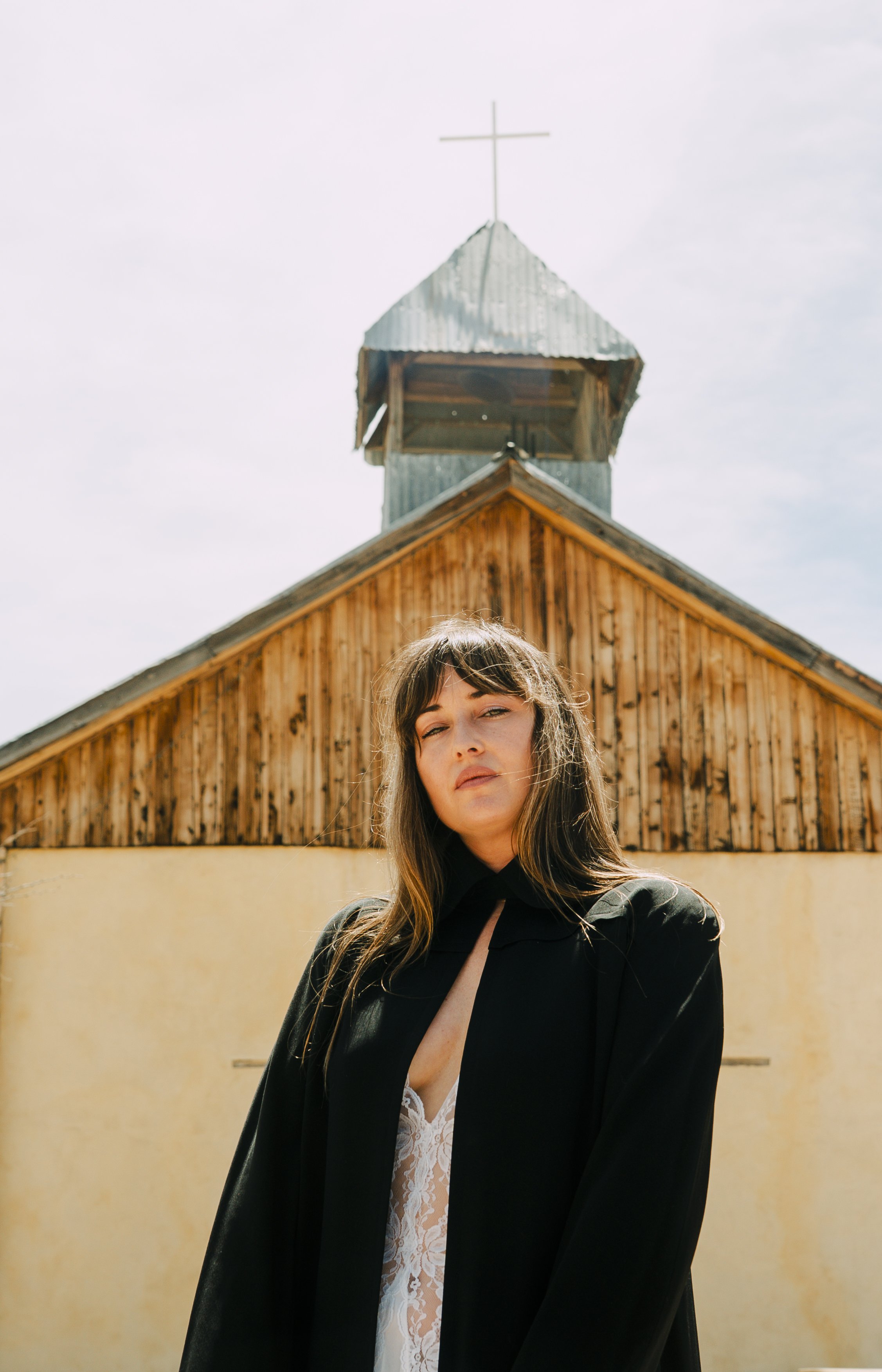
The major takeaway from A Mile South of Heaven is that perfection is a fallacy, outside validation is a losing game, and heaven isn’t a reachable place but a singular feeling that lives inside a person who is at peace with herself.
On the album, Williamson’s voice is the most powerful it has ever been. The songs are some of the best she’s ever written because she was secure enough in herself and her abilities to allow them to be simple, bold, and true.
This is echoed in the album’s gatefold image, in which Williamson sits in what she refers to as the “cowboy” pose, shot in Terlingua, Texas, at the very cabin mentioned in the album’s final song, “The Gem and Mineral Show”—a hand-built adobe constructed by her partner’s father in the 1970s.
Williamson describes this song as encompassing one of the main points of tension on A Mile South of Heaven: being torn between two extremely opposite places. In the song, she sips champagne at the Chateau Marmont with a pop star (the “Queen of Americana”) and also attends a gem and mineral show in rural Texas.
“An off-grid cabin in Terlingua is about as far away as you can get from a Grammys after-party at the Chateau Marmont,” she explains. “And yet, I found myself somehow allowed in both spaces but feeling like a tourist in each. The last line of the album is: ‘I am a tourist here, I come and I go.’ And in the grand scheme of life, aren’t we all?”
“Hum of the City,” the album’s seventh song, is similarly about the spiritual push and pull between life in the city and life in the country. It evocatively recounts how someone can love both locations so much that they never feel fully at peace in either.
“High Heels and Blue Jeans,” the second track, is at its core a story of survival—the many ways we perform in order to endure seemingly impossible situations.
A Mile South of Heaven is the sound of someone who left home for the land of seekers, strove for an ever-elusive goal, and ultimately chased the horizon long enough to realize it can never be reached. These songs reject the myth of arrival in favor of something richer: a life lived in motion, where fulfillment is found not at the end of the road but somewhere along it.
The album’s cover image echoes that revelation. Williamson drives the truck but also looks within herself in its side-view mirror. A mystical light flare demonstrates the magic of those dual positions.